

What Veterinary Leaders Need to Know Before Changing PIMS
Changing your veterinary PIMS is not just a software decision.
It is an operational decision.
A workflow decision.
A leadership decision.
And, if it goes poorly, a culture decision.
One of the biggest mistakes I see veterinary hospitals make is treating software implementation like a technology project instead of a team project.
Because the reality is this: The people choosing the software are often not the people absorbing the fallout.
And that disconnect matters more than most leaders realize.
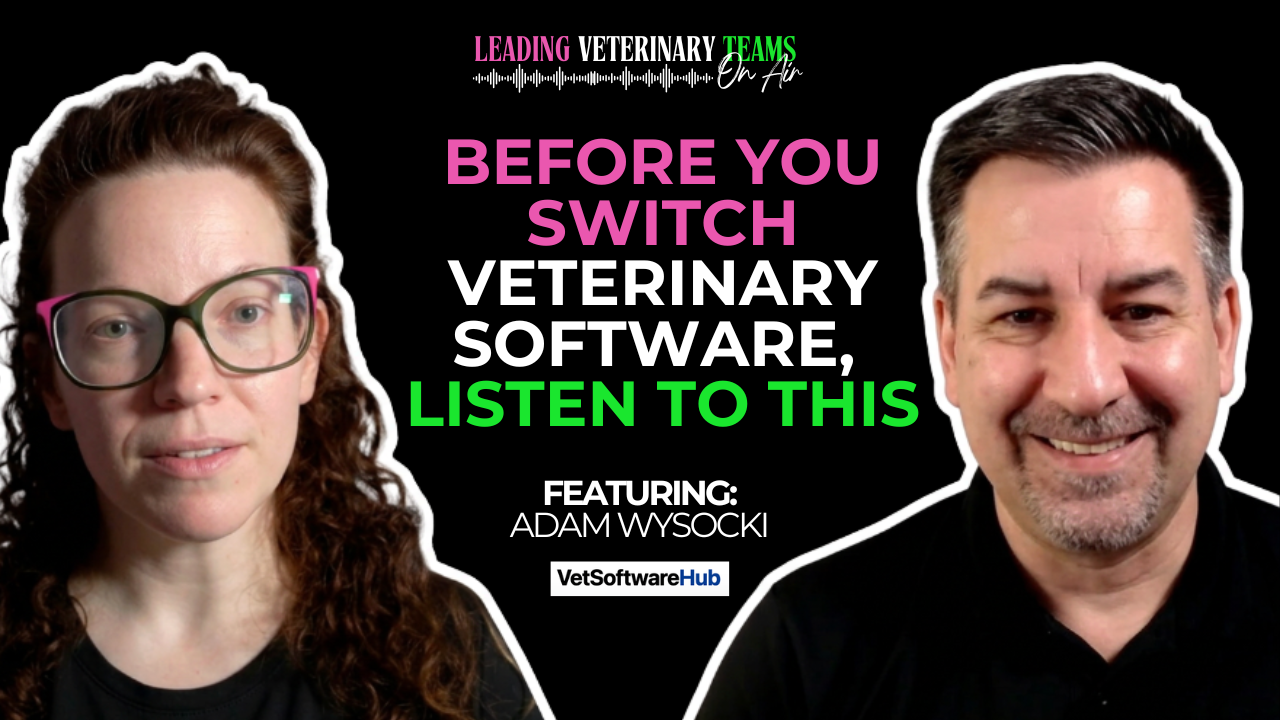
In this week’s episode of Leading Veterinary Teams on Air, I sat down with Adam Wysocki, founder of VetSoftwareHub.com, to talk about veterinary software, PIMS transitions, AI in veterinary medicine, workflow mapping, and why so many veterinary teams end up creating workarounds just to survive the systems they’re supposed to be working inside of.
Adam spent more than 35 years building software, including serving as CEO of a veterinary software company before launching VetSoftwareHub — the largest independent veterinary software directory online. But what made this conversation so valuable wasn’t just the technology side of it.
It was the operational side.
Because if you’ve ever lived through a PIMS transition inside a hospital, you already know:
The software itself is only part of the story.
Nobody Really Trains Veterinary Leaders How to Buy Software
One of the things Adam said during this conversation that immediately stuck with me was this:
“The demo is the midway point — not the start.”
And honestly? He’s right.
Most veterinary leaders are thrown into software evaluations with little to no formal training on:
workflow mapping
implementation strategy
integrations
contract negotiation
operational impact
change management
data migration
or post-go-live support
Meanwhile, software sales teams are professionally trained in:
demos
objection handling
negotiation
buyer psychology
closing contracts
That imbalance creates a lot of unnecessary frustration for veterinary hospitals.
And I’ve seen it firsthand.
I’ve personally lived through multiple PIMS transitions in veterinary hospitals. Some smoother than others. Some that felt manageable. Others that felt like operational chaos wrapped in training documents and sticky notes.
One of the hardest parts isn’t even choosing the software.
It’s surviving what happens after go-live.
The Hidden Operational Cost of Bad Software Decisions
What often gets missed in conversations about veterinary software is this:
Every software decision creates downstream operational consequences.
If workflows become more complicated:
technicians feel it
CSRs feel it
doctors feel it
managers feel it
clients feel it
And eventually?
Patients feel it too.
One of the strongest parts of this conversation was hearing Adam talk about walking into hospitals and seeing:
laminated workaround sheets
paper inventory logs
duplicate documentation systems
sticky notes covering monitors
teams compensating for software limitations manually
That’s not a technology problem.
That’s a systems problem.
And over time, those systems problems become burnout problems.
Because every extra click, every workaround, every broken integration, every manual process adds cognitive load to teams that are already overloaded.
Why Workflow Mapping Matters Before You Ever Book a Demo
One of the biggest takeaways from this episode was the importance of mapping workflows before evaluating software.
Not after.
Before.
Adam talked about helping practices document:
check-in workflows
client communication
treatment processes
technician responsibilities
discharge procedures
inventory systems
data entry patterns
operational bottlenecks
Because if you don’t understand how your hospital currently functions, you can’t properly evaluate whether a new system actually improves anything.
And too often, practices choose software based on:
flashy demos
marketing
peer recommendations
vendor relationships
conference exposure
instead of operational fit.
But there is no universally “best” PIMS.
There’s only:
the best fit for your specific workflows.
That distinction matters.
AI Is Not Replacing Veterinary Teams
Another part of this conversation that I’ve continued thinking about was Adam’s comparison of AI to GPS navigation.
AI is not there to replace clinical judgment.
It’s there to support decision-making.
To reduce friction.
To streamline repetitive tasks.
To augment workflows.
To improve efficiency.
But leadership still matters.
Critical thinking still matters.
Human connection still matters.
And honestly, I think one of the biggest mistakes leaders can make right now is viewing AI as either:
a magical solution
oran existential threat
Instead of seeing it for what it actually is:
A tool.
A powerful one.
But still a tool.
The hospitals that will navigate this technology shift best are not the ones resisting change entirely.
They’re the ones learning how to implement change intentionally.
The Part Veterinary Leaders Need to Pay Attention To
One of the most important themes underneath this entire conversation was ownership.
Not just ownership of software decisions.
Ownership of operational outcomes.
Because once a system goes live, the team still has to work inside of it every single day.
And when teams are not included in:
evaluations
workflow conversations
implementation planning
feedback loops
they often end up feeling like change is happening to them instead of with them.
That’s where resistance grows.
That’s where morale drops.
That’s where operational trust breaks down.
Good implementation is not just technical.
It’s relational.
What I Want You To Do This Week
1. Make a list of every workaround your team currently uses.
Sticky notes.
Paper logs.
Manual duplicate entry.
Spreadsheets.
Verbal reminders.
Whiteboards.
“Temporary” processes that became permanent.
Every workaround is data.
It tells you where your systems are failing your people.
2. Ask your team this question:
“What part of our software slows you down the most?”
Then just listen.
Don’t defend it.
Don’t explain it away.
Don’t jump immediately into problem-solving.
Just listen.
You’ll learn more than you think.
3. If you are considering changing PIMS:
Do NOT start by booking demos.
Start by mapping workflows.
That one shift alone changes the entire evaluation process.
Listen to the Full Episode
-
In this episode, we discuss:
veterinary software
PIMS transitions
AI in veterinary medicine
workflow mapping
implementation mistakes
open APIs
veterinary operations
cloud software
data ownership
leadership during organizational change
-
Suzanne Thomas LVTg, CVTg (00:01.88)
Make sure we're recording. OK, sounds good. Cool. All right. Cool. You ready? Cool. Welcome back to Leading Veterinary Teams on Air. I'm your host, Suzanne Thomas. And if you've been following me for any amount of time, you know that I talk a lot about systems and structures that either support veterinary leaders or quietly work against us. One of the places that shows up
Adam Wysocki (00:12.162)
Ready.
Suzanne Thomas LVTg, CVTg (00:30.734)
One of the places that that shows up is technology. The software your team lives inside every single day. The platforms that are supposed to make the work easier sometimes do the exact opposite. Today's guest has been building software for over 35 years. He's started five companies, has left three or had three exits, has spent five years as a CEO of a veterinary software company, and then walked away from that role to do something that honestly feels
overdue for our industry. He gives practices straight answers about technology without a sales pitch attached. Adam Wysocki, did I say that right?
Adam Wysocki (01:12.396)
You did. Perfect.
Suzanne Thomas LVTg, CVTg (01:13.544)
great, Adam Isaki is the founder of VetSoftwareHub.com, the largest independent veterinary software directory on the internet with over 180 products across 23 categories. There is no referral fees, no sponsored placements, and no glossy demos without the fine print. Adam's site focuses on the information that hospital leaders actually need to make the real decisions. He's also a cat dad.
to four, so he gets veterinary medicine from more than just one angle. And honestly, I'm excited about this conversation because software decisions are some of the most expensive, most disruptive choices a hospital can make. And most leaders are navigating them without a real playbook. Adam has spent the last year building that playbook for this industry, and I think what he's doing matters. So Adam, welcome to the show.
Adam Wysocki (02:12.248)
Yes.
Suzanne Thomas LVTg, CVTg (02:13.104)
who don't know who you are, which I don't know if you are on LinkedIn how you could miss who Adam is, but for people who don't know who you are, can you tell us a little bit about you, why VetMed, and what made you decide software was your thing?
Adam Wysocki (02:29.252)
Yeah, so I wrote my first software program in 1984. I was a kid. Funny, I'm old. In 1984, I went and saw the movie Gremlins and I wanted to play a Gremlins video game, but I couldn't find one. So I wrote one and then I started selling it to my friends in school and I got caught and I got in trouble. So I've been an entrepreneur and a software developer for a long time.
Suzanne Thomas LVTg, CVTg (02:55.694)
You
Adam Wysocki (02:59.14)
But out of high school, I joined the Marine Corps. I was fortunate enough to get into a software development job in the Marine Corps, a lot of schooling. And right as I was getting out is when the dot com bubble started. And I was very fortunate to be early engineer at some companies that went public and were acquired and just love the startups and software and building solutions that make life better for people.
My whole life, I've been an animal lover. I wanted to be a marine biologist when I was a little kid. I've always had pets and always had, in my adult life, good relationships with veterinarians. Many of them started out as my doctors for my pets and became friends. So I always had a deep love for the career and just being in veterinary hospitals to me feels normal.
When I was recruited to VitisVet about six, little six-ish years ago to head product and engineering and help kind of bring some innovation to that product, I was all in. The team was great, the clients were great, I loved the industry. And I now have a goal of wanting to retire in the veterinary industry. I've worked in human health and sports technology and
I worked in the cannabis space building software for a while, but veterinary med has the best people. Just really honest and heartfelt people, amazing people who give and give and give. And now I want to be part of that and I want to give as well.
Suzanne Thomas LVTg, CVTg (04:44.075)
Yeah, yeah, I mean, I think that.
what you're touching on is absolutely astonishing, right? Like you spent time with people in the hospitals as a client and making friends with them and saw a need, right? And so tell me a little bit about the pivot from being
at VitusVet and being this CEO of this organization, this software company, and then deciding to go out on your own, right? Why did you decide to walk away and become an independent voice for the people buying that software?
Adam Wysocki (05:21.731)
Yeah.
Adam Wysocki (05:28.844)
Yeah, so I think, you know, Vitas VET was acquired last year and I, you know, I had the opportunity to go with the acquiring company, but I wanted to do something different. And I think two things happened during my time at Vitas VET. You know, I was normally a builder and a product guy and a little bit on the operation side. But as a CEO, you have to sell and you have to talk to your customers and understand the sales process. And I started doing
Sales demos and and a lot of sales demos and you know, of the things that was very Eye-opening to me is that I would be on demos and and I would say do you have any questions and the hospital? Professionals that were on the call would would say no they would just stare at me the whole 30 minutes and nod their heads and and I would say well Do you want to ask about? contract terms Do you want to ask about how we secure?
Suzanne Thomas LVTg, CVTg (06:23.981)
you
Adam Wysocki (06:24.908)
Your data and then yeah yeah yeah so that was always like I always tried to be helpful probably a lot of sales people are watching this going don't do that. But I thought it was important right and then the other thing too is as a small company I just that struggled in this landscape of veterinary software where essentially if you're not spending you know a million dollars on a booth at VMAX giving away margaritas.
Suzanne Thomas LVTg, CVTg (06:27.565)
you
Adam Wysocki (06:51.94)
Nobody's listening to you, right? Like it is very hard to get attention in the space. So when, you know, by time at VitisVet ended, I thought there was an opportunity to kind of do two things. One, teach veterinary professionals how to evaluate software and how not to get caught in the gotchas. And two, help good technology find its way to veterinary professionals.
regardless of what the marketing spend was. So, like a matchmaker, so to speak. the other thing too that I think is important to note is as a leader, power imbalances were something that I was always constantly aware of with my team, in client relationships, and I think...
Suzanne Thomas LVTg, CVTg (07:29.698)
Yeah.
Adam Wysocki (07:46.868)
One of things you think about a software sales demo, there's an incredible power imbalance in the veterinary space because the average practice manager or hospital owner gets no training on how to evaluate software, on how to be that acquisitions person, what kind of questions to ask. And the average sales rep is getting coaching on selling, objection handling, contract negotiation. We didn't have a huge budget when I was at Vitus.Bet, but even I paid for those coaches.
for our sales reps. And it is not fair, right? So I think that's the other thing that is really driving me is to kind of bring that fairness to that conversation.
Suzanne Thomas LVTg, CVTg (08:27.821)
Yeah, that's a really good point. The first time that I was in a director of operations seat, one of the first things that I was asked to do was a PIMS integration. And I didn't really...
know what that meant. Aside from prior to that, I had worked at VCA and at the time VCA was creating their own PIMS. So I went through the Woofware thing as a specialty technician. prior to, I don't know how much you're familiar with that, but Woofware in VCA started on the GP side and I was part of the group of the specialty side trying to figure out how
make it work in specialty. And so I worked in oncology and we were like, great. So I was the oncology technician trying to figure out how this PIM system would work in our, in our department, including adding all the codes and doing all the things. And so fast forward all of these years now, that's why you see me posting things like
Adam Wysocki (09:12.814)
how to make it work.
Suzanne Thomas LVTg, CVTg (09:38.306)
Does anybody ask the technicians any of these questions? Cause I was that technician, right? But going back to what I was saying before, walking into that clinic or that group of clinics and being asked to do this PIMS integration, it had already started. I was like coming in the back end of it. I had no idea what questions to ask. Cause I had only ever experienced it in a company that was creating their own. And I like joined this meeting and I was like,
Adam Wysocki (09:41.08)
Yeah. Yeah.
Suzanne Thomas LVTg, CVTg (10:08.533)
So where are we? Like talk me through where all the things and the organization that we were going to was telling me where we were. And I was so lost because I was like, wait, we, nobody asked any of these questions. Nobody knew, nobody had any idea what questions to even ask in the beginning. So now I'm at the backend trying to ask all these questions that I thought made sense to have maybe asked when we were even deciding what pins to go by and
Adam Wysocki (10:37.111)
yeah
Suzanne Thomas LVTg, CVTg (10:38.253)
I was like, oh my God, what's happening? Because nobody even knew to ask those questions. But because I had been on the floor for so long, I already had these things going through my mind to ask, right? So to your point, right? Like nobody trains you those. I just had the wherewithal to know we should be asking some more questions. We were just too far along to even start that question and answer period. So I guess we're have to figure this out now.
It was really rough.
Adam Wysocki (11:07.364)
I built the website, and I thought I was just gonna write articles and I was gonna list software, and practices would just figure it out. And what I realized pretty quickly is, I'm asking a lot, when the calendar's full and there's a dog seizing in the back room and there's a client throwing medications at the CSR at the front desk because they're pissed off about their bill, nobody has time to figure it out.
Suzanne Thomas LVTg, CVTg (11:15.34)
Yeah.
Suzanne Thomas LVTg, CVTg (11:32.321)
Yeah.
Adam Wysocki (11:36.396)
So I started doing some consulting and helping practices. And the very first one I did was a practice, they were on an on-prem PIMS for 18 years. And the practice manager, late 30s, and she had started as a kennel tech in high school. It's the only job.
Suzanne Thomas LVTg, CVTg (11:55.394)
And for people that don't know what that means, that means on premises, right? Like not cloud. Yeah.
Adam Wysocki (11:58.98)
So it's on a server in the back closet typically. You know older older technology not yet in the cloud, which a lot of hospitals are still there. But so she started as a kennel tech. It's the only job she's ever had. You know she moved from kennel tech to vet tech to she was inventory manager for awhile. Finally became practice manager and she said, you know, could you help me? My owner wants to go to the cloud and get a cloud PIMS this year.
Suzanne Thomas LVTg, CVTg (12:09.324)
Yes.
Adam Wysocki (12:27.842)
And I said, well, what do you know about the process? And she goes, nothing. I don't know how to start. Right. And that was the first one I did. And it was, you my heart went out to her because, you know, I said, you know, well, what's, what's your biggest worry? You know, you're worried about like picking this the wrong one and everybody hates you. And she goes, no, I'm worried that our patients are not going to get the best care possible because of my decision. And that I was like all in.
after that and I said, we're gonna get you through and I created this process that I use now during that and it's a step by step and one of the big things that I said is look, we're gonna map all your workflows. I wanna understand what is check-in like? What is new client onboarding like? How are you taking subjective in the exam room? When does the doctor come in? Everything. And we built a blueprint and then we went out to the cloud providers and we said, show us this.
And they said, no, no, we have this slide deck and we have this demo. And I said, I don't care about that. That's, that's irrelevant. Right. Show us this. and that's how it all started. And they've now been on the cloud PIMS that they chose for almost a year and they're tickle pink. Like, so, and the transition process was painful. Moving 18 years worth of data from one system to another. It did not go smoothly. the first 90 days, I thought they were going to kill me.
Suzanne Thomas LVTg, CVTg (13:32.833)
Yeah. Yeah.
Suzanne Thomas LVTg, CVTg (13:48.268)
It is.
Adam Wysocki (13:54.148)
as well as the on-prem vendor and the cloud vendor, but they got through it. And they learned a lot about how they operate as a team. And they're in a really good place right now. And I'm really proud of working with all the clients that I have, but that one especially, because it was my first one.
Suzanne Thomas LVTg, CVTg (14:12.289)
Yeah, no, it's a lot when you don't know what you're walking into. I think that having that person that can kind of help walk you through and answer some of those questions must be really helpful for them, but also probably was really eye-opening for you to realize how little we really know, we being the people in the field, right? Like really know about what...
is being asked of us and to that point, was that experience part of the deliberate choice to take no referral fees and to not have any sponsored placements? What kind of was the driver of that?
Adam Wysocki (15:01.006)
So I think the driver of that is if I start taking referral fees, even if I am building a non-biased system for selection, there is always potential doubt. Somebody can say, it ended up this company looked like the best choice for us. Is it really though? And then there's a potential for living with regret, right?
And I don't want anybody to go through this painful process and go, man, this is not going great. Did we pick this because it was the right thing for us or because that guy is getting a referral fee? And I said, look, if I can be completely vendor neutral and just give an honest representation of the software and let practices make their own decision, I'm giving tools, not recommendations.
I was I was recently on a podcast and people were asking questions and you know, what's the best PIMS? What's the best AI scribe and I was like, I don't know like Every how you can have two hospitals three miles apart. Their workflows are completely different Right and the best PIMS for a is not going to be the best PIMS for B. So you can't pick one And that fits every hospital and that's kind of the problem with veterinary software these days is they build
Well, one size fits all. you just, know, a two-doctor practice in Tulsa, Oklahoma is not the same as a 22-doctor specialty referral hospital in Philadelphia. Like, totally different.
Suzanne Thomas LVTg, CVTg (16:40.309)
And to be fair, might not even be the same as the two-doctor practice down the road in Tulsa, Oklahoma. Right?
Adam Wysocki (16:45.444)
That that's right. So I my my famous quote that I I tell every practice when I start work with them is you get 100 veterinary professionals in a room and you ask him how they how to do something. You'll get 100 different answers. And then 10 minutes later you'll get 50 more right like. So it's it's very important to structure a process that documents how that practice works and then see how the different software options fit. Into that workflow.
Suzanne Thomas LVTg, CVTg (16:58.241)
Yeah.
Adam Wysocki (17:14.828)
And then choose the one that fits, nobody's gonna fit perfect. Choose the one that fits the closest and you will be fine when you come out of the other end.
Suzanne Thomas LVTg, CVTg (17:25.421)
So a lot of the people listening to this podcast are hospital managers, lead technicians, some practice owners, people who are carrying the operational weight of the hospital every single day, right? They're living inside of these systems, likely the ones that are actually implementing the PIMS or implementing the new AI scribe or whatever the software is, not necessarily the ones approving.
the new AI scribe or the new PIMS. What do you hear from that layer of leadership when you're talking to them about their software experience?
Adam Wysocki (18:05.966)
Yeah, I think, you know, a lot of the practices I work with are small independent GPs. And I think they do a little better at team cohesion than some of the larger groups. And what I hear when I talk to larger groups, especially when there's a top down methodology for implementing software is, you know, gee, I wish somebody would have talked to us. Right. We don't work like this at all. I hear.
quite often, right? But it's amazing the resilience of all of you that work in these positions that say, all right, this is the hand that we've been dealt. We're going to make it work. And you do, right? With some caveats, and it breaks my heart when I go into a practice that's owned by a larger group and I see a laminated sheet
on the monitor of the CSR with like workarounds for getting a form signed off on by a client. Or like a super modern tech forward hospital, yet there's a clipboard hanging by the inventory room with a string and a pen hanging off of it because they can't update inventory in the software the way they've been doing it for the last 10 years. So they're writing it on paper.
Suzanne Thomas LVTg, CVTg (19:13.517)
500 Post-its.
Adam Wysocki (19:34.296)
Right, and that's a side effect of somebody looking at a system maybe miles or states away and saying, hey, this is a great system, we're gonna roll it out across all our hospitals without getting that bottom up feedback. I understand both sides of it. mean, my heart goes out to those hospitals that have to make those workarounds, but when you have...
50 locations, 100 locations, 400 locations, it's 400 different workflows, right? So whatever you pick is going to be wrong, right? And if you let them all run their own programs, then you're doing 400x the work at the corporate level to assimilate the data and build your reporting and understand the performance of your investment. So there's no winner.
Right? Everybody kind of loses in that game. I think software will get better. I think there's a lot of efforts now to address adaptable workflows and making sure that software can address different workflows, different ways of doing business under one brand, under one umbrella. But I think we're still a little while away from that.
Suzanne Thomas LVTg, CVTg (20:59.863)
for the hospital leaders that.
are starting an evaluation of these different programs. What do you find are the most common mistakes when right at the start of that evaluation? I know you mentioned right off the bat that there's a lot of questions and a lot of things that you were finding that they weren't even asking. What are some of those things that you identified really early on that
they weren't asking. I mean, Advaita's vet, you were asking for them, but now even, you what are you finding that are still some of the things that you're kind of helping them through early on in the evaluation?
Adam Wysocki (21:37.816)
Well, yeah.
Adam Wysocki (21:46.552)
Yeah. So the number one message, if I could share one tip, is the demo is not the start. The demo is the midway point. And it's so common, and you've probably seen this in your career, like, OK, we want to get this software. Well, let's schedule some demos. What a huge mistake, right?
because now you're gonna have a vendor lead you through a show and tell of their product and typically the decision goes to the vendor that you like the best. Why'd you choose that? I liked it, right? We liked it. The start of the process is your tech stack. It's make a list of everything that you currently are using software-wise, right? Because that's your base point if there's potential integrations or systems that need to work together.
And that goes for labs and online pharmacy, you know, all of those touch points this the systems that your team is in and then you know a clearly defined list of Your must-haves what must this product do? For me to say yes and want it and this is all before you book the demo, right? And then what you're nice to haves and then like what are your things you could live without right like AI scribe, know, I could live without like
Discharge instructions we do those it's not a big deal or discharge instructions are a must-have in the scribe And then from that list you can start doing your research and seeing you know two or three vendors That fit right okay. They have these things they they don't have this, but that's okay. I don't really need that And that way you don't have to do ten one-hour demos right you two or three one-hour demos much better And then you know
Create a script like these are the workflows. This is the problem that we're trying to solve and have the demo, you know 24 or 48 hours before the demo. Send that script to the the the sales rep and say hey, I want you to go through this demo like we're using it. And that's you know, that's the best way to start. You want to be able to see yourself and your staff in those workflows during the demos and that will help you understand whether or not.
Adam Wysocki (24:06.884)
this is gonna fit.
Suzanne Thomas LVTg, CVTg (24:09.367)
That's a really good idea and a idea wasn't the right word, a good example, right? Because I think that most of the time we're getting demos and we're just going through whatever they're giving us and.
that may or may not be what we're actually doing. And I don't know about you, but for me, I'm one of those people that needs to actually play with it to know if it's going to work for me. And I can watch you do something 15 times and until I actually start playing with it, I won't know if it's actually going to do the thing that I need it to do. Do you also recommend asking for like a sandbox or something like that to play with?
Adam Wysocki (24:50.702)
That's right.
Adam Wysocki (24:56.644)
Always. Always, know, like, depending on the software, like AI scribes, you can download them to your phone. For practice management software, a sandbox is key. And then so the other part of that is, is have a little structure. don't like, you know, go in a sandbox and click around. Oh, this is neat. This is cool. Like that's, that's not an evaluation. like, say, you know, you're really proud of
Suzanne Thomas LVTg, CVTg (25:17.995)
Yeah.
Adam Wysocki (25:24.964)
how you check in clients, right? Our check in process is really streamlined, we've worked for it, clients love it. All right, so time your check in, right? Your check in process now step by step, time it. How long does it take with your current software? Now go into the sandbox and replicate that process. You might find that it takes a minute and half longer in the sandbox than it does with your current system. Well that's, right? That's not gonna be cool.
OK, maybe it's new, you know, I'm just getting used with software. So you do it a couple times during your lunch. Do it when you have over 30 days if you can get the sandbox for that long. It doesn't get better or does it stay still a minute and 30 longer than? Well, that's a red flag. Then I would, you know, really there would have to be some other benefits to workflows to make up for that. But having that structure, having a game plan going in as opposed to just.
Suzanne Thomas LVTg, CVTg (25:55.149)
Right.
Adam Wysocki (26:21.732)
clicking around and seeing if you like it, you're going to set yourself up for much better success once it's actually implemented, if you see those improvements in the sandbox.
Suzanne Thomas LVTg, CVTg (26:33.005)
What do you say to people who are really have no idea how long this process takes? Like I had a hospital manager who she came to me and she was like, I'm gonna change my PIMS from this, you know, on premises to a cloud-based and we're gonna, I'm so excited. We're gonna be launching in like three weeks. And I was like, hold up. No, you're not.
Adam Wysocki (26:57.284)
Yeah.
Suzanne Thomas LVTg, CVTg (26:59.273)
And she was, what do you mean? And I tried to explain to her all of the things that she was gonna have to do. And she didn't realize how time consuming this process was gonna be for her. What do you say to people when they realize and then their face is like, like I have to give up that much time. I have give up that much time.
Adam Wysocki (27:18.744)
Yeah, so a well-run structured evaluation process, assuming that you're going to look at two or three or four different options, that's a minimum of six weeks to really map all your workflows. And that's really putting an effort in it. That's the low end of when I work with a hospital that it takes to get through all of that. Sometimes it could be eight or 10.
Suzanne Thomas LVTg, CVTg (27:40.257)
Yeah.
Adam Wysocki (27:48.548)
I'm working with just using the evaluation, right? I mean, how many practice managers can give up four hours a week to sit in four demos? typically it's one hour on a Thursday afternoon, maybe each week, right? And I have a hospital I'm working with now, super motivated, really organized, really moving through it responsive, and then two doctors resigned. And now they're like,
Suzanne Thomas LVTg, CVTg (27:49.495)
And that's just the evaluation. Yeah, we haven't even decided yet.
Adam Wysocki (28:18.564)
Once we fill these doctors, we'll get back to you. Don't like, you know, I get it, right? So there's curve balls that comes up, know, you're, you're somebody on your team gets sick or a car accident or whatever, right? So you're going to account for those things. And then once you make the decision, um, that migration process can be four weeks. It would be a miracle if it was done in four weeks, you know, you.
Suzanne Thomas LVTg, CVTg (28:20.993)
Yeah.
Yeah.
Suzanne Thomas LVTg, CVTg (28:31.618)
with.
Adam Wysocki (28:46.934)
I've seen 16 weeks, right? 12, I think, is probably a number that I would say is realistic, because you've got staff training, you've got your first data export, and you're relying on three companies, right? The company you're moving from, the company you're moving to, and your company, to all be in sync and be able to be responsive to each other. It just doesn't happen as fast as you think.
Suzanne Thomas LVTg, CVTg (29:12.875)
Yeah. And you've talked a lot about APIs and all of that. I'm sure that is part of that, right? Like if every, for people who don't know what that means, it's like the, correct me if I'm wrong. It's the software is talking to each other, right? It's the ability for all of the software is to be able to.
Adam Wysocki (29:19.064)
Yeah.
Adam Wysocki (29:29.71)
That's right.
Suzanne Thomas LVTg, CVTg (29:33.769)
integrate and talk to each other. So, and that's the very like simplistic version of what that is. So if you don't have all of that integrated and talking to each other, that makes it take even longer, I assume. Yeah.
Adam Wysocki (29:46.776)
Yeah, so typically you know the reason I talk about API API is just it's a way to use software to get data out of your you know to get your data out right? And you know what a lot of practice management software's do is that like they'll allow you to pull out user records and soap nodes, but you can't pull out invoices. Right, or you can't pull out.
Suzanne Thomas LVTg, CVTg (30:12.972)
Yeah.
Adam Wysocki (30:16.686)
Client relationships, so spouses or whatever, so that you lose those. So it's the what you can't pull out that makes these migrations very difficult. There's one I know that if you put weights in in a certain way, you can't get those back out. So now like,
Suzanne Thomas LVTg, CVTg (30:30.976)
Yeah.
Adam Wysocki (30:42.628)
to hire somebody to move all your weight data manually from the new system to the old system. That could take more time. Or you just abandon it and say, we'll start doing new weights. I don't know. So yeah, the reason I'm such an advocate for open APIs is because I believe that a hospital's second biggest asset beyond the land and their facility, if they own it, is their.
Suzanne Thomas LVTg, CVTg (30:54.828)
Yeah.
Adam Wysocki (31:08.376)
their data, you know, especially if you think about 1530 years of data and to give it to somebody in the cloud and say, hey, I'm going to pay you every month to store this data and let me use your web interface to access it. And then to say, you know, I need it back. And they go, well, we can only give you this much back. That's something that has to change in this industry, right? You should be able to get back everything that you put into it. You know, text messages.
invoices, AR notices, whatever. that would make these PIMS transitions so much better. Right? Because...
Suzanne Thomas LVTg, CVTg (31:49.441)
Do you find that they can actually, can they get it back if they pay for it? Like, or it's gone.
Adam Wysocki (31:56.132)
Sometimes it's gone. Sometimes some segment of the data is just gone. It's trapped in that system with no way for that company to give it back.
Suzanne Thomas LVTg, CVTg (32:02.093)
Hmm.
Suzanne Thomas LVTg, CVTg (32:08.235)
So do you recommend from the get-go that those are some of the questions that they're asking?
Adam Wysocki (32:14.18)
Yeah, I one of the questions that I always have practices ask during demos or or to the sales rep afterwards is, you know, can you provide me with a list of if we were to leave what data comes out and what data I can't get back? Right?
Suzanne Thomas LVTg, CVTg (32:30.477)
Yeah.
Yeah, I had a PIMS in it was, I won't bore you with the details, but it was a very strange, it was a strange enough situation that the company had never seen it. It was like a back and forth thing.
I think I've actually told you about this one, but it was a weird back and forth thing. And ultimately wound up that the only fix that we had was that we had to manually input the invoice data. So we had to go into the old PIMS and manually do all of the invoices so that we could get back the records of when these patients had their vaccines and
I was like, it was only two months of data, but it was still like, how many patients did you see in two months, right? It was like 500 and something patients that we had to manually input. And I was like, I don't want to do this. So again, it was because there was no way to pull that data.
Adam Wysocki (33:22.156)
Yeah. Yeah.
Suzanne Thomas LVTg, CVTg (33:37.129)
no way to, and I just was like, what do mean there's no way to pull that? Like there's so much sophisticated things out there that we can't pull this data from the cloud. Whatever cloud is out there. can't give me my data.
Adam Wysocki (33:53.924)
It's in a database somewhere, right? But you
Suzanne Thomas LVTg, CVTg (33:57.39)
Right, I mean, it's gotta be somewhere. I mean, I have it, so I can pull it manually. I can see it. You can't pull that from this thing here to... I have to physically do it.
Adam Wysocki (34:06.136)
Yeah, and put it in a spreadsheet for me to use somewhere else, right? Yeah, it's a good fight and I'm fighting that battle every day. think that these companies are listening. I talk to a lot of them behind the scenes. They kind of grumble at me a little bit. And some of them are just downright nasty about it, but very few.
Suzanne Thomas LVTg, CVTg (34:11.329)
Yeah.
Adam Wysocki (34:35.67)
So I think there's changes coming. think what's really interesting now with AI, right, is what most people who aren't super tech nerds with the propeller beanies like me, what they don't know is that in the future, software is gonna radically change because of AI. Like if you're a Gmail user today, you know what Gmail looks like. In a year or two, Gmail is gonna look
however you want it to look. Because you're just going to tell Gmail to like, hey, I want all email from my cousin to be purple. AI will just do it. It'll just make it however you want. So software is going to be very much like that. And the PIMS companies are going to have to adapt to it. And the way AI is going to make those interfaces dynamic and customized is by having access to data.
through APIs. So the PIMS companies, because of consumer demand, are going to have to open up this data and make these APIs available to be able to have these modern interfaces that practices are going to want. Like you can't tell me that I can customize my Netflix, I can customize my Gmail, I can customize the screen on my refrigerator, but I can't customize the PIM I'm paying thousands of dollars a year for?
Suzanne Thomas LVTg, CVTg (36:00.962)
Right, but you can't pull the invoice data from my old PIMS. Right, right. You were on a Vetfolio, you were talking about AI, so you were on a Vetfolio AI panel recently, and you posted on LinkedIn about someone who asked a question about de-skilling, and you said that you haven't been able to stop thinking about it since. Can you talk a little bit about what that question was and where your...
Adam Wysocki (36:04.408)
That's right. Right.
Adam Wysocki (36:11.725)
Yeah.
Suzanne Thomas LVTg, CVTg (36:30.401)
thinking landed, especially for the people that are running and training teams right now.
Adam Wysocki (36:32.225)
Yeah.
Adam Wysocki (36:37.112)
Yeah, think it was a series of questions that a very insightful person asked about, and the gist of it is, is AI going to make me worthless? Is it going to take over and I'm not going to be a sharp because I'm relying on AI, it's going to be able to do the things that I'm counted on for? I have these conversations all the time with people in practice.
And I think this is really common when new technology comes, right? And it's scary, and we don't know what it's gonna look like, and we don't know, like, it gonna be better than me? Well, I say, yeah, I hope so, because if you've ever had to drive in a car with me to somewhere I didn't know where I was going, and I didn't have Google Maps, you would be screaming at me, like...
Suzanne Thomas LVTg, CVTg (37:33.11)
yeah.
Adam Wysocki (37:33.774)
I have you driving in circles like so like, you know, I use Google Maps or ways to get places, but I don't use it to go to the grocery store, right? It hasn't taken away. It hasn't taken away. You know the knowledge I have to get to my doctor's office or the grocery store, right? Like. That's just me. Those are things I know, but you know if you were going to ask me to drive into Manhattan, yeah, I'm using ways.
Suzanne Thomas LVTg, CVTg (37:35.405)
you
Suzanne Thomas LVTg, CVTg (37:45.826)
I think it's.
Adam Wysocki (38:03.554)
I'm not winging that one.
Suzanne Thomas LVTg, CVTg (38:05.069)
I'm GPS for, not because I don't know, like, okay, so I will use my GPS.
to places that I know how to get to, not because I don't know how to get there. I use it because I want to know how long it's going to take and like traffic and stuff.
Adam Wysocki (38:21.048)
Right, so you're using it as a tool to augment something that you already know. And this, GPS is such a great example, right? Because to me, it's a decision support tool. Some GPS systems, know like Waze, and even Google Maps to some degree, will alert you to traffic and find you a way around that traffic before you even see that traffic, right? It doesn't mean you don't know how to get to that place or you couldn't.
Suzanne Thomas LVTg, CVTg (38:24.045)
Right.
Suzanne Thomas LVTg, CVTg (38:44.801)
Right.
Adam Wysocki (38:51.172)
run into that traffic and then figure out a back road around it, you're a smart person, right? It's just a tool to help you augment. But like, if the GPS system ever said, hey, go down this one-way street the wrong way, you probably wouldn't do that, right? And that's, think, right. And so, just as a GPS can, you know, maybe the road's closed, maybe there's a tree down and the GPS doesn't know that.
Suzanne Thomas LVTg, CVTg (39:05.645)
Right. Right. I'd be like, absolutely not.
Suzanne Thomas LVTg, CVTg (39:17.804)
Mm-hmm.
Adam Wysocki (39:18.168)
Now you've got to figure out a way around it. And then once it sees you start doing that, it then helps you pick up. So I think when we think about AI in practice, we should think about it a lot like a GPS. For the things that we just know how to do, we don't need it. Or maybe we do, like, I don't want to open my calculator. I can just ask AI, and it'll give me a dosage or something like that.
But it's a great tool and I think for me, and this resonates when I talk to lot of professionals, I have, I'm not a creative person. So when I have to write something, like an email, I in my head wrestle with what I'm gonna say before I even start typing and then I delay it and it doesn't happen. AI is such a great tool for like...
Framing a conversation and then like once I see it. Oh, yeah, but I don't want to say it like that I want to say like this right so you think about those like AR collection emails right like nobody wants to send those So hey chat GPT. have to collect nine hundred and seventy dollars from this client who hasn't answered their phone in six months Could you draft an email for me to politely ask? When the hell they're gonna give me the money, right?
Suzanne Thomas LVTg, CVTg (40:15.947)
Yeah.
Suzanne Thomas LVTg, CVTg (40:35.01)
Yeah.
Adam Wysocki (40:35.652)
And that's another great use it's not taking away from you You could write that email if you wanted to you don't want to but you could But it's it's just a tool to augment what you already do and you know, there's I Think there's gonna be very little tolerance for AI from pet owners getting in the way of a doctor's clinical decision or a staff's recommendation or care
Suzanne Thomas LVTg, CVTg (40:43.467)
Yeah.
Adam Wysocki (41:03.94)
But I think there is a scenario where you look at like error rates, right? I think AHA did an article or AVMA did an article where the error rate in veterinary decisions is like 5.8 out of 1,000, right? So a human decision has a 0.05 % error rate. Well, if an AI decision is 0.01,
As a pet owner, I'm gonna ask my doctor, like, I wanna hear what you think, but are you double checking against this? Right? And again, it's a tool that kind of augments the process.
Suzanne Thomas LVTg, CVTg (41:44.462)
Sure. I think for me with leaders, think that it's important that we still, kind of going back to your AR example, I like the example. I think that it's a good tool to use, kind of to your point, right? It's a good tool to use, but I would err on the side of caution of using it.
without then looking at it and right. Like I think that sometimes people hear that and then they're like, oh cool, I'll just use that and then send it. I think that we have to just be careful to not forget that we have to use it and then put it in our own voice also. Like you had said that before, I just want to like reiterate that. If you're going to use it for a client communication, for AR or to fire a client or even to like give yourself
Adam Wysocki (42:11.076)
Oh, 100%. Yeah.
Adam Wysocki (42:28.598)
Yeah. Yeah. And, I'd go
Suzanne Thomas LVTg, CVTg (42:38.095)
yourself the words because for like a for a leader, maybe you don't yet have the words to have that uncomfortable conversation, whether it be for a client or for a staff member or for a doctor or whatever it is, right? Maybe you don't yet have those words. So you go to AI and you say chat GPT or Claude or whoever. Hey, help me with these words. You get the words, but you still need to
you still need to have the conversation and you still need to put them in your words because otherwise it's not, it's disingenuous and it's performative and it's not you. And I think that the more you practice it, you saying it, the less you then have to go to AI to do it for you. And then it becomes more natural for you to do it. And then it, do you see where I'm going there?
Adam Wysocki (43:31.81)
Yeah, I do. And I think it goes back to, you know, like I was talking about with the GPS, like, you're not going to let Waze take you down a one-way road the wrong way, right? You're not going to let Waze drive your, you're not going to drive into a tree that's across the road because Waze says go that way, right? I never, when I use AI, when I have writer's block and can't come up with ideas, I never say like, write this for me. I always say, you know, give me three ideas that I can develop.
Suzanne Thomas LVTg, CVTg (43:32.853)
Okay.
Suzanne Thomas LVTg, CVTg (43:39.649)
Yeah.
Suzanne Thomas LVTg, CVTg (43:44.385)
I hope not. Yeah.
Adam Wysocki (44:01.444)
based on I need to do this. And then I look at the ideas and then I write in my voice. But sometimes just getting over that anxiety of, I've got to create this thing, I don't know what to say, I think is a very powerful tool to seed those thoughts for your words. But I agree, nobody wants to talk to a robot or a machine. They want to connect with you as a person.
But as a person with anxiety over how do I have this conversation, it's a very powerful tool to help me have more certainty in what I'm going to say.
Suzanne Thomas LVTg, CVTg (44:42.125)
100%. And I completely agree. I do it. And I think that it's a really powerful training tool to train yourself how to have those conversations. just, I felt like it was necessary to just reiterate, because you said it, I just wanted to make sure that like, we don't miss that point of like, don't just ask it to write the email and then hit send. Like I will know 100 % as the client that you used AI to write that email. You don't.
Adam Wysocki (44:58.22)
I agree.
Suzanne Thomas LVTg, CVTg (45:11.583)
you don't want to do that. Those emails, as simplistic as they might seem, there's a reason why you don't want to write it, right? Because it's uncomfortable. Well, guess what? It's just as uncomfortable to receive it. So if you can keep the humanity in it slightly, it lands a little bit softer. And AI doesn't have humanity. So we need to keep that in there a little bit. So just...
Adam Wysocki (45:13.218)
Yeah, yeah, no, I.
Adam Wysocki (45:40.996)
Yeah, 100 % and you know, I I I was talking to a practice manager a couple weeks ago and I said, you know, you wouldn't use AI. You know if you had to, you know, call a client with bad news right, you would want to have that conversation directly. You would want that to be your words, right? And I think that's how you have to think about. These conversations, but it certainly is a tool like a GPS to help you navigate.
Suzanne Thomas LVTg, CVTg (46:00.675)
Yeah.
Adam Wysocki (46:09.71)
to where you want to be. And then I think that, and I think you said this, you pointed out, over time, you need it less and less, right? It helps you get into a flow state where like, this is my 77th AR email, I know what to say. I don't have to ask Chet GPT for some ideas on how to land this thing.
Suzanne Thomas LVTg, CVTg (46:09.941)
Yeah. Yeah.
Suzanne Thomas LVTg, CVTg (46:29.345)
Yeah.
Suzanne Thomas LVTg, CVTg (46:34.157)
Yeah. You're presenting at Cornell's SAVI conference, right?
Adam Wysocki (46:41.922)
Yeah. Yeah. Symposium on artificial intelligence and veterinary. I don't know what the Y is.
Suzanne Thomas LVTg, CVTg (46:49.549)
It's a, and you're talking about what PIMS look like in this AI world, right? Can you talk a little bit about that?
Adam Wysocki (46:59.684)
Yeah, yeah, no, this is yeah. So the idea is, I think what's going to happen with AI and computer interfaces over the next several years is the interface is going to be less important, right? We're seeing, we're already seeing a lot of speech, like my wife bangs out 30 text messages at a shot coming home from work talking to the car, right?
Suzanne Thomas LVTg, CVTg (47:28.225)
Yeah.
Adam Wysocki (47:29.078)
Like I used to be the guy like, and I'm embarrassed to admit this, like driving and texting and my wife smacking me in the head, right? She's so good at voice interface while she's driving and getting messages and telling me to thaw out ground beef or whatever. So there's gonna be so much voice interaction with computers in the future and not just computers, like your refrigerator, your washer and dryer, like hey, set.
delicate cycle, go, right? So the UI is not going to matter much. I think you'll be able to use AI and AI tools to create custom interfaces. And imagine being able to spin up a dynamic interface that shows a patient's weight history and, you know,
blood levels historically against current lab results. So you have your labs interface and your patient record history all in the same graph instantaneously, right? Design that for me and done. In order to do that, we're have to have more access to data in the PIMS and the PIMS web interface is not gonna be as important as it is today because everything will be an interface with the PIMS. So what do the PIMS become?
it becomes a very, very secure data store that's highly governed. So with audit trails, you could see every single thing that's happening in it. You can get data in, you can get data out, permissions. There's rate limiting, so you can't have an AI that's trying to hammer your database and take up all the resources. It'll be able to tell AI to back off a little bit or slow down. And I think one of the most exciting things is
access control by key people in the hospital. So what a lot of people don't realize now is those databases in cloud PIMs, the engineers at those software companies can see your data. They can log into the database environment and do queries and see your raw data. I think the PIMs of the future, if an engineer at your software company wants to look at data to support, to fix a bug or understand an issue that you're having, you'll get a pop-up on your phone or...
Adam Wysocki (49:50.148)
that says, know, Steve Smith is requesting access to your data for this bug and you say yes or no, right? And then you can selectively give lab companies access to data if you need to or if you wanted to participate in a pharmaceutical study, you can give them limited access to a subset of the data down to, you know, where it would mask client and patient detail information but just give maybe historical blood work.
Suzanne Thomas LVTg, CVTg (49:57.921)
Mm-hmm.
Adam Wysocki (50:18.51)
for this one species. So I think there's a lot of really cool innovations that can come from us thinking about the PIMS as a very secure, governed, yet accessible data store for AI, but with full control in the hands of the people that own the data instead of the software companies taking your money to host the data.
Suzanne Thomas LVTg, CVTg (50:45.293)
For me, I wonder what that means for the hospital manager who doesn't speak any of the words that you just said. Like, what does that actually mean for her and how her team works day to day?
Adam Wysocki (50:52.749)
Yeah.
Adam Wysocki (50:58.5)
Yeah, so probably nothing, right? Those highly governable PIMs will come with a user interface like they do today, and if you're not gonna do any of those things, fine. But imagine you have a client that comes in and says, hey, I just got this new health tracking dog collar, and I would love to send
Suzanne Thomas LVTg, CVTg (51:24.439)
Mm-hmm.
Adam Wysocki (51:27.972)
heart rate, weight into my medical record. Can we do that? And you say, yeah, sure. And you tap a device on the collar, and now that device has access to just that patient's weight and heart rate data and temperature, right? And can make those updates. And you can revoke that at any time. You don't have to do anything other than say yes and maybe tap a, scan a QR code and
Suzanne Thomas LVTg, CVTg (51:39.533)
Everything just sinks.
Adam Wysocki (51:58.208)
send it into the PIMS.
Pretty cool, right? And now if you're a large practice group or maybe you're just a 10 location smaller practice group and a pharmaceutical company comes to you and says, look, we're doing a study for chronic kidney disease. We love to analyze blood work from cats over the last 10 years. Could we have access to your PIMS? They scan a QR code or a pop-up comes up in your dashboard. Company X wants to access, yes.
and it just accesses the blood work data that they need and nothing else.
Suzanne Thomas LVTg, CVTg (52:40.097)
That was actually pretty cool.
Adam Wysocki (52:42.532)
It's, I think the future is very bright. I think there's a lot of applications for AI to improve animal care that I'm very excited about. And I think the bridge that we have to cross now is, know, PIMS and hospital data and, you know, keeping it very secure, putting the control in the hands of the people that own it and not the companies that are storing it.
Suzanne Thomas LVTg, CVTg (52:47.138)
Yeah.
Suzanne Thomas LVTg, CVTg (53:12.107)
So you launched Vet Software Hub in September of last year. You recently shared that you hit a million Google search impressions in seven months without running a single ad, which I think is really cool. What does that number tell you about what this industry was missing?
Adam Wysocki (53:17.44)
Yeah.
Adam Wysocki (53:34.564)
It tells me that there is a lot of people asking questions in Google and certain LLMs, AI engines about software. And there are some really good resources out there, but they're very scattered. Some of the PIMS companies have great articles about
And the AI Scribes companies have great articles about AI Scribes. But there's no repository that really kind of collects all of that together. So I think what I'm benefiting from is the concentration of a lot of that information in one place, which is getting me into a lot more searches than a typical single source software company would get.
There's just a lot of natural curiosity about, you know, pins and AI and AI scribes. AI reception is a, you know, is a term that gets, is getting searched more and more lately. so I, you know, I feel like I'm blessed to be in the right place at the right time, which I think is half of the benefit, but I really focused early on, on search discovery because I, you know, I'm a, I'm a solo founder. I'm never going to take investors.
Suzanne Thomas LVTg, CVTg (54:42.507)
Yeah.
Adam Wysocki (55:01.572)
I'm trying to run this thing with myself, my wife's help and some AI agents. So search was my best way to get discovered and my big mouth on LinkedIn too, it helps a lot.
Suzanne Thomas LVTg, CVTg (55:15.681)
I mean, that's how we met, right? You're also writing a book on that. What's it about and who should be reading it when it comes out?
Adam Wysocki (55:17.668)
Yeah.
Yes, ma'am. Yeah. Yeah.
Adam Wysocki (55:26.788)
Yeah, so it's about PIMS transition, how to do a PIMS evaluation. I think it's, like you said, it's one of the most critical transitions that hospital's ever gonna do. The fact that nobody's ever written a book about it before is kind of shocking. PIMS have been around since the late 80s digitally. So, like the things we talked about, building, auditing your tech stack.
building your list of must haves, demo scripts, how to evaluate contracts, how to understand total cost of ownership under hidden fees, things like that. End to end, kind of like a cookbook, but I'm surveying practice managers and owners because I want to interject real stories. That first practice manager that I helped with a PIMS change.
I said to her, know, well, what have you done so far? And she said, I went on some Facebook groups and asked, you know, what's everybody's favorite PIMS? And, everybody that said my favorite PIMS is X, 10 other people would say, that sucks. Don't use that. And she said, I feel so alone, right? So I want to add stories of people that have done it and people that have done it and failed and had to go back and people who'd done it and succeeded. that
If you're reading it because you're going through a PIMS transition or thinking about it, you don't feel alone. You're not the first person to do this. You're not the only person to do this. And here are some things that these people would have done different. And maybe you can use them to help make it little easier for you. So that's the gist of the book. It'll be cheap. don't want to, I'm not doing it to make money. I'm doing it because...
the information needs to be out there. And over the next probably five to seven years, 16,000 hospitals will end up likely moving from a server in their office to a cloud pins. And that is a lot of angst and anxiety and stress and panic. And if I can help just a smidge of that, I will feel pretty good.
Suzanne Thomas LVTg, CVTg (57:43.95)
Well, I think what you're doing right now, even pre-book, is helping people more than a smidge. So keep doing what you're doing, write your book, and I'm really excited to see what comes out of that because honestly, the few PIMS transitions that I have gone through...
Adam Wysocki (57:54.52)
Yeah, I hope so.
Suzanne Thomas LVTg, CVTg (58:09.869)
have not been great. And so, you know, any help that one can get, I think is really great. So
Adam Wysocki (58:20.43)
There's a graphic that I'm gonna put in the book and I love it and it's two mountain peaks and there's a thin frayed rope between the two and there's a practice manager walking across and the rope looks like it's about to break and then somebody says, stay right there, we've just gotta switch out the rope real quick. And that is a PIMS transition in a visual, right? And it, man, I've never met anybody that says, hey, I loved it.
Suzanne Thomas LVTg, CVTg (58:39.485)
Yeah. Yeah.
Adam Wysocki (58:49.528)
Right? They all suck, right? I just try and help it suck less.
Suzanne Thomas LVTg, CVTg (58:52.119)
Yeah.
Suzanne Thomas LVTg, CVTg (58:55.937)
Yeah. I think for me, and I don't know what your thoughts are on this, but for me, the biggest or the thing that I wasn't anticipating with the PIMS transition was what happens after Go Live. And I've now learned.
to ask those questions. But the first one I didn't know to ask those questions. I just assumed that you were handheld afterwards. And that is not the case in all of them. And I've transitioned now to a handful of different PIMs. And so now I do know a couple of different companies and what that looks like. So I know what to ask. But.
I'm asking you this question, I'm just giving this information freely as advice to anyone listening. Ask that question of what that looks like afterwards because sometimes once you go live it's like, out.
Adam Wysocki (59:57.888)
And you know, like you have to understand, you know, company roles and responsibilities and employees have goals and milestones that they're measured against for their bonuses and promotions, right? And you know, the salesperson, their goal is to get you to sign that contract, then they're done, right? They don't, they get nothing more from helping you after that.
Suzanne Thomas LVTg, CVTg (01:00:05.858)
Yeah.
Suzanne Thomas LVTg, CVTg (01:00:14.05)
Mm-hmm.
You can pay for that though. Like you can pay for more. But you don't know if you're not the person who has paid. If you are just the person who is like if you're the hospital manager and you are the one who is being asked to implement the thing and you aren't the one who is actually paid for all of this stuff and signed the contract, you might not have the visibility, which is the case and which was my case in a couple of these until later on when I did have the visibility. But
Adam Wysocki (01:00:20.802)
You can pay for worse.
Suzanne Thomas LVTg, CVTg (01:00:44.895)
in a couple of these situations, didn't have the visibility to even know that what I had available to me. So there is usually the opportunity to have more afterwards. But if the person who is signing the contract doesn't necessarily pay for that afterwards, you might be...
Adam Wysocki (01:00:51.224)
That's, yeah, that's a good point.
Suzanne Thomas LVTg, CVTg (01:01:08.127)
shit out of luck. So you should ask what you have available afterwards so that you can better prepare yourself and better prepare your team for what happens afterwards. Because if you are thinking, okay, we're going to go live and then I'm going to have all of these things and then you don't, you're going to be pissed off. But if you already know that you don't, then you're not going to be upset, right? Like if I ask the question and I know what I have or what I don't have, then I
won't be upset. I was upset with a company that what I found out that I actually didn't have available to me. I shouldn't have been upset with them because that wasn't their fault, right? Anyway, I digress.
Adam Wysocki (01:01:46.082)
Yeah. Yeah. I, when I do engagements and it's a, it's a hospital owner, that reaches out to me, I always say like, let's get your practice manager on the meeting. Right. That's the first step. and then during the engagement, we, we structure ways to keep the entire team involved, right. In, you know, in the, the must haves and nice to haves conversation in mapping the workflows and then in onboarding and implementation.
Suzanne Thomas LVTg, CVTg (01:01:56.47)
Yeah.
Suzanne Thomas LVTg, CVTg (01:02:05.399)
Yeah.
Adam Wysocki (01:02:15.332)
I love gamifying, like, hey, first person to get a consent signature gets a $5 gift card. First person to print a report gets a $5. Give the team some incentives or break it up into teams to see who can figure out the new system first. And it makes everybody feel a little better. But a lot of times, owners have a very myopic view of how it's going to go.
And then especially if they're also practicing DVMs and they just go back to work and they're like
Suzanne Thomas LVTg, CVTg (01:02:51.499)
Yeah, well, because change is hard, right? And like changing a whole system is a lot for everyone.
There's a lot of different pieces and so I love that gamifying and getting everybody involved is super important Before we wrap this up Is there anything that we haven't talked about that is on your heart that you would want people to know either about AI or PIMS or what you're doing anything that we haven't talked about
Adam Wysocki (01:03:22.85)
Yeah, just like a couple couple to reiterate a couple points. If you're a practice manager that has to go through a PIMS transition in the future, you're going through it now like definitely not alone. Lots of people do it. Some parts of it are going to be miserable. You will survive. There are resources available, not you know I do paid consulting, but everything that I consult is on my site in articles. So like if you didn't want to do an engagement, you can still do everything that I do.
Um, and then on the AI front, uh, everybody should be playing with AI, even if it's like five minutes at night while you're, you know, having a snack before bed because it's coming. I've been doing this for, you know, over 36 years. I've seen all kinds of technology fads come and go. And you know, the, closest I can equate to what's happening with AI is in 1850, it took 45 days to plant.
for a farmer to plant an acre of crops. When the tractor came out, they shortened that to four hours. That is the significance of AI in the future in everybody's world. So if you're afraid of it, fair, but you can take little steps, get a chat GPT, know, ask it, know, just ask it what, you know, this is my favorite movie, what did you think? And it's just fun to see the answer.
Right, and the more comfortable you are today playing around with it, the more you're setting yourself and your team up for success in the future.
Suzanne Thomas LVTg, CVTg (01:04:58.933)
Adam, are you a reader?
Adam Wysocki (01:05:01.604)
Um, I, yes, when I have time. Um, yeah, a little bit. Um, I, get, I get behind that. have like five books going right now all at the same time.
Suzanne Thomas LVTg, CVTg (01:05:04.407)
Okay. All right, all right.
Suzanne Thomas LVTg, CVTg (01:05:11.965)
Rapid Fire, always ask everyone, what is one book, it doesn't have to be leadership or AI or software related, it can be anything. Rapid Fire, what is one book you would recommend everyone on this planet read? Go.
Adam Wysocki (01:05:25.156)
Everyone on this grit by Tammy Duckworth.
Suzanne Thomas LVTg, CVTg (01:05:28.235)
It could also be one of the ones you're reading right now. doesn't really matter. Grit.
it's not up there. I have it, but it's not.
Adam Wysocki (01:05:36.676)
It is one of my favorites. If you want to get a little more bro-y, David Goggins, the idea that when you think that you've got nothing left, you're only at about 14 % of what you're capable of. Yeah.
Suzanne Thomas LVTg, CVTg (01:05:58.434)
I'm looking around because I have books everywhere and I have both David Goggins' I have his book and I also have grit, but I don't have either of them near me. They're in the other room. I was going to show them and be like, look, these.
Adam Wysocki (01:06:06.02)
Yeah. Yeah, I am. I am not an athletic person in general, but I challenge myself to do big athletic things for the grit aspect. So I, you know, I've run marathons and I've done a 50 mile ultra marathon. did an Ironman a little over a year ago. So like, I really believe that you have so much more in you.
Suzanne Thomas LVTg, CVTg (01:06:27.469)
Yeah.
Adam Wysocki (01:06:34.826)
And if you can find that place, you can do anything.
Suzanne Thomas LVTg, CVTg (01:06:38.197)
Yeah, yeah, Gaggins is wild, but yeah, for lots of reasons, but I agree.
Adam Wysocki (01:06:45.368)
When my wife and I walk at night, always like, random as one of us will say, who's going to carry the logs?
Suzanne Thomas LVTg, CVTg (01:06:51.789)
If you as a listener or watching have never heard of David Goggins, just do a quick YouTube search and you will understand that man is something else. So yeah, you want some, you know, motivation to get up off the couch, just listen to him for two seconds and you'll be like, okay, I'm going.
Adam Wysocki (01:07:19.94)
I mean, the hyper masculinity machoism gets a little much after a while, his spirit, yeah, his spirit is incredible, right?
Suzanne Thomas LVTg, CVTg (01:07:24.479)
Yes. You just have to like get past that a little bit, but like also. Yeah. Yeah, for sure. Well, listen, Adam, it has been absolutely incredible chatting with you today. For anyone who wants to connect with you, where can they find you?
Adam Wysocki (01:07:44.068)
That's off our hub.com is the the website I am a shameless LinkedIn poster so if you can find me on LinkedIn search Adam Wysocki you connect with me there or You can email me. It's Adam at that software hub comm I would love to to chat and hear your thoughts on software when I started this thing I said I'm gonna take every meeting and that I that is still going
So I'll meet with anybody who wants to talk about software. I stay in my lane though, so I can't help with anything outside of software.
Suzanne Thomas LVTg, CVTg (01:08:20.725)
Awesome. Well, thank you so much for being here, Adam. Thank you everyone for listening. If this episode hit home, share it with a colleague who's got a software decision coming up. Leave a review if you haven't yet. If it genuinely helps more leaders to find the show. I'll see you guys next time on Leading Veterinary Teams on air. Keep leading.
-
VetSoftwareHub:
www.vetsoftwarehub.comConnect with Adam Wysocki on LinkedIn:
https://www.linkedin.com/in/the-adam-wysocki/Take the Free CLARITY Assessment:
https://suzanne-xlfkmtbz.scoreapp.com/Join the Leading Veterinary Teams Community:
www.lvt.vet/community